
Polis’s Parole Violation

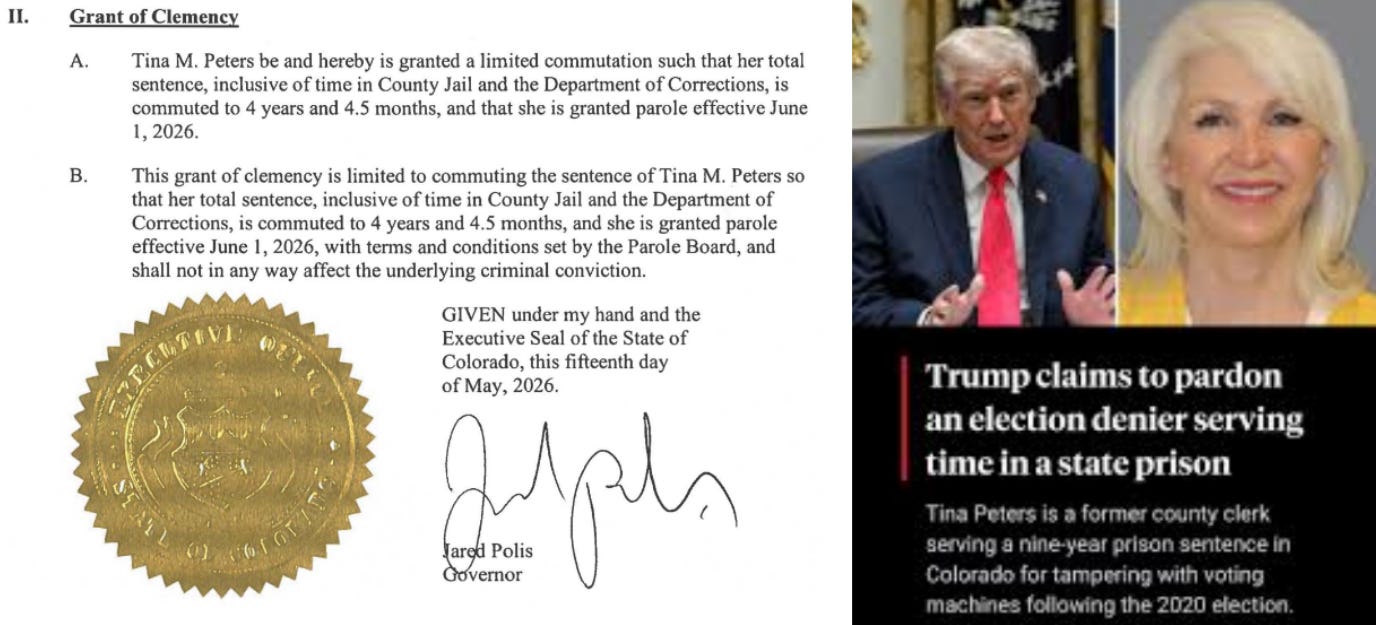
In a Substack post that he published on the eve of the June 1 release of Tina Peters, Gov. Jared Polis invited still greater scrutiny of his behavior in this case.
As I noted in my own May 25 post, Polis justified his decision to cut in half Peters’s nine-year sentence on an appeals court’s April 2 ruling. In agreement with the argument of Peters’s legal team, the appeals court found that at sentencing the trial judge had improperly punished her for her First Amendment-protected speech. Here in part is what the appeals court wrote in remanding her case back to the trial judge for resentencing:
[I]t is apparent that the court imposed the lengthy sentence it did because Peters continued to espouse the views that led her to commit these crimes.
[...]
[T]he court’s improper consideration of Peters’s protected speech to impose a longer prison sentence necessarily means the error was substantial.
Thus we remand the matter for resentencing.
It disappoints me to continue to see some Polis critics misrepresent him as having excused her crime on First Amendment grounds. He has always expressed clearly that the reason for his action was the sentence, not her prosecution and conviction. It disappoints me more, however, to see Polis advance a bogus argument for a crucial aspect of his intercession in her case.
As I noted before, the appeals court having remanded Peters’s sentence, it was incumbent upon the trial judge to take corrective action per the order of the appeals court. Instead of supporting regularity in our judicial system and promoting faith in it, Polis further politicized the Peters case by reducing her sentence himself, in preemption of the trial court. He vastly compounded the damage by circumventing the normal parole process and directing that she be released on parole on June 1.
All of that was bad enough. In his essay, Polis added insult to injury. Here is how he explained why he injected himself into this case (emphasis added):
Earlier this month, I granted clemency to Tina Peters, reducing her sentence from 8¾ years to 4⅜ years, with a corresponding parole date of June 1, 2026. The reaction, positive and negative, was immediate and intense.
[...]
Some have asked why I did not simply allow the courts to continue the process. The answer is simple. Any path through the courts would likely have taken years of appeals. I wanted to provide finality to this case, and as Governor I used my constitutional power of clemency to do what I believe is right, just as I did in the case of trucker Rogel Aguilera-Mederos who was guilty of and convicted on multiple charges, including vehicular homicide and was originally sentenced to 110 years which I reduced to ten years, a more typical sentence for his horrible crimes.
Polis’s action in the case of Rogel Aguilera-Mederos is similar in one respect and substantially different in a consequential other. A jury found Aguilera-Mederos guilty of vehicular homicide in October 2021 and Judge Bruce Jones, citing guidelines, sentenced him to 110 years. The prosecutor in Aguilera-Mederos’s case, District Attorney Alexis King, expressed the view that the 110 year sentence was too harsh and made a formal request for a resentencing hearing, which Judge Jones granted on December 22. Same as in the Peters case, Polis preempted the resentencing hearing, which had been scheduled for January 2022, and unilaterally reduced the sentence (to 10 years, in line with what District Attorney King indicated would be appropriate).
Up to this point, Polis’s actions in the two cases are indeed similar. However, the first paragraph of Polis’s December 30 clemency letter to Aguilera-Mederos makes clear a crucial difference (emphasis added):
I am writing to inform you that I am granting your application for a commutation. After learning about the highly atypical and unjust sentence in your case, I am commuting your sentence to 10 years and granting you parole eligibility on December 30, 2026.
Polis exercised his prerogative to make Aguilera-Mederos eligible for parole on a date that occurs exactly five years after the date of his clemency order and roughly five years before the conclusion of Aguilera-Medero’s reduced sentence. In stark contrast, Polis ordered Peters released on parole essentially immediately, while roughly two and a half years remained on her reduced sentence.
In his Substack essay, Polis misled his readers with the assertion that in addition to reducing Peters’s sentence he granted her “a corresponding parole date of June 1, 2026.” There is nothing inherently “corresponding” about his having ordered her release. In this highly politicized case, it would have been better had he done the same as he did in the Aguilera-Mederos case and merely moved up her eligibility for parole. Peters’s nearly immediate release is extraordinary, and a mistake.
It may very well be the case, as Polis asserted, that the Peters case “would likely have taken years of appeals” to arrive at full resolution. However, in declaring that he “wanted to provide finality to this case,” Polis revealed that he elevated his own desire – whatever the personal and/or political considerations that underlay it – over crucial interests that go beyond justice in this particular criminal case. Of much greater importance is confidence that our justice system can stand strong and resilient in the face of political manipulation. In the context of the current administration’s relentless onslaughts, the mere appearance that Peters received special favor as a concession to such pressure is deeply damaging.
Yes, "Peters’s nearly immediate release is extraordinary, and a mistake." Thank you for clarifying the details & facts of Polis' grant of clemency to Tina Peters, a dangerous, unapologetic election denier.