
Flag Day Reflections on “Impostures of Pretended Patriotism”

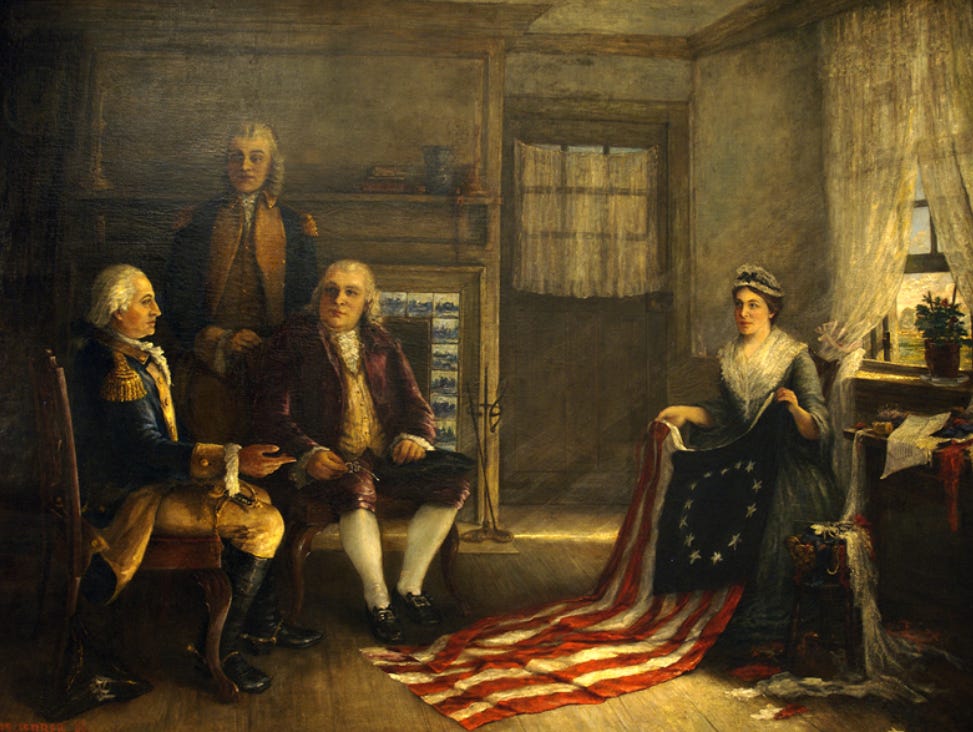
George Washington was indispensable to the launch of the American experiment as the commander of the Continental Army that won the Revolutionary War, president of the Constitutional Convention that produced our charter of freedom, and first president of the United States. According to folklore – memorialized in C.H. Weisgerber’s 1893 painting Birth of Our Nation’s Flag – Washington was also instrumental to the design and production of that flag, purportedly by Betsy Ross.
We celebrate Flag Day today, on June 14, because it was on this date in 1777 that the Second Continental Congress specified the design of the flag, with these words: “Resolved, that the Flag of the thirteen United States shall be thirteen stripes, alternate red and white; that the Union be thirteen stars, white on a blue field, representing a new constellation.” In 1949 Congress enshrined the commemoration in law.
In a message to the American people published in September 1796 and later known as his Farewell Address, Washington announced that he would not stand for election to a third term. After indicating his commitment to retire and thanking the people for the trust and support he had received, Washington proceeded to “offer to your solemn contemplation, and to recommend to your frequent review, some sentiments which are the result of much reflection, of no inconsiderable observation, and which appear to me all important to the permanency of your felicity as a people.”
The lengthy document provides valuable guidance and political insight. Washington devoted considerable space to the danger of extreme partisanship (emphasis added):
I have already intimated to you the danger of parties in the state, with particular reference to the founding of them on geographical discriminations. Let me now take a more comprehensive view and warn you in the most solemn manner against the baneful effects of the spirit of party, generally. This spirit, unfortunately, is inseparable from our nature, having its root in the strongest passions of the human mind. It exists under different shapes in all governments, more or less stifled, controlled, or repressed; but in those of the popular form it is seen in its greatest rankness and is truly their worst enemy.
The alternate domination of one faction over another, sharpened by the spirit of revenge natural to party dissension, which in different ages and countries has perpetrated the most horrid enormities, is itself a frightful despotism. But this leads at length to a more formal and permanent despotism. The disorders and miseries which result gradually incline the minds of men to seek security and repose in the absolute power of an individual; and sooner or later the chief of some prevailing faction, more able or more fortunate than his competitors, turns this disposition to the purposes of his own elevation on the ruins of public liberty.
This all sounds very prescient and familiar. Washington continued (emphasis added):
Without looking forward to an extremity of this kind (which nevertheless ought not to be entirely out of sight) the common and continual mischiefs of the spirit of party are sufficient to make it the interest and the duty of a wise people to discourage and restrain it.
It serves always to distract the public councils and enfeeble the public administration. It agitates the community with ill founded jealousies and false alarms, kindles the animosity of one part against another, foments occasionally riot and insurrection. It opens the door to foreign influence and corruption, which find a facilitated access to the government itself through the channels of party passions. Thus the policy and the will of one country are subjected to the policy and will of another.
Again, very familiar. Further (emphasis added):
There is an opinion that parties in free countries are useful checks upon the administration of the government and serve to keep alive the spirit of liberty. This within certain limits is probably true—and in governments of a monarchical cast patriotism may look with indulgence, if not with favor, upon the spirit of party. But in those of the popular character, in governments purely elective, it is a spirit not to be encouraged. From their natural tendency, it is certain there will always be enough of that spirit for every salutary purpose. And there being constant danger of excess, the effort ought to be by force of public opinion to mitigate and assuage it. A fire not to be quenched, it demands a uniform vigilance to prevent its bursting into a flame, lest instead of warming it should consume.
Washington spoke as well of the importance of upholding the Constitution’s separation of powers, its checks and balances. Here again he speaks directly of our times (emphasis added):
It is important, likewise, that the habits of thinking in a free country should inspire caution in those entrusted with its administration to confine themselves within their respective constitutional spheres, avoiding in the exercise of the powers of one department to encroach upon another. The spirit of encroachment tends to consolidate the powers of all the departments in one and thus to create, whatever the form of government, a real despotism. A just estimate of that love of power and proneness to abuse it which predominates in the human heart is sufficient to satisfy us of the truth of this position. The necessity of reciprocal checks in the exercise of political power, by dividing and distributing it into different depositories and constituting each the guardian of the public weal against invasions by the others, has been evinced by experiments ancient and modern, some of them in our country and under our own eyes. To preserve them must be as necessary as to institute them. If in the opinion of the people the distribution or modification of the constitutional powers be in any particular wrong, let it be corrected by an amendment in the way which the Constitution designates. But let there be no change by usurpation; for though this, in one instance, may be the instrument of good, it is the customary weapon by which free governments are destroyed. The precedent must always greatly overbalance in permanent evil any partial or transient benefit which the use can at any time yield.
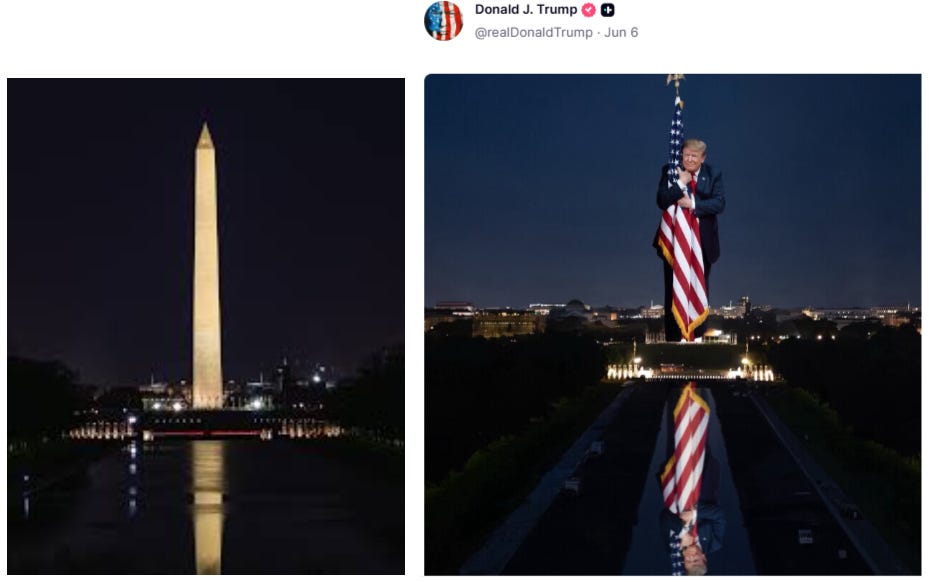
Before reading a final excerpted paragraph from the address, understand the images that I have placed at the top of this essay. On the left is a nighttime image of the Washington Monument. To the right is an AI-generated image that the president of the United States posted on his social media platform along with dozens of others on a single day earlier this month. The image superimposes over the Washington Monument, such that the Monument is not visible at all, an enlarged picture of him hugging an American flag. The president has replaced Washington with himself.
As The Daily Beast reported, the president posted this flood of bizarre AI images not on some random day but on June 6, the anniversary of D-Day. The entire day, the president uttered not a sound nor shared a single image in honor or commemoration of American heroes. Instead, he celebrated himself and attacked political opponents. Let that information stand as introduction to a final excerpt from Washington’s Farewell Address (emphasis added):
In offering to you, my countrymen, these counsels of an old and affectionate friend, I dare not hope they will make the strong and lasting impression I could wish—that they will control the usual current of the passions or prevent our nation from running the course which has hitherto marked the destiny of nations. But if I may even flatter myself that they may be productive of some partial benefit, some occasional good, that they may now and then recur to moderate the fury of party spirit, to warn against the mischiefs of foreign intrigue, to guard against the impostures of pretended patriotism—this hope will be a full recompense for the solicitude for your welfare by which they have been dictated.
Thank you for sharing President George Washington's thoughtful, comprehensive warnings against the conditions and human nature that has brought America to "a frightful despotism" on this Flag Day.