
Dignity, Character, and Virtue
These values are essential not only in our leaders but in ourselves.

“America’s revival will never begin with a stronger man. It will begin with better citizens. It will begin when dignity is once again admired instead of mocked. It will begin when character once again outweighs celebrity. It will begin when Americans decide that virtue is not quaint — it is essential.”
The quote above is the final paragraph of a June 19 essay titled “The Dignity Gap.” In his conclusion, the author voiced a sentiment that I have communicated many times. In December 2025 I published “For a New Great Awakening.” In that essay I quoted extensively from an essay that Ian Bassin and Paul Raushenbush had published just days before. Indulge a repeat of one of those passages:
Such an awakening would not ask us to agree on every doctrine or policy. It would ask something at once both simpler and harder: that we recover a shared moral horizon. That we remember democracy is not only a system of government but a practice of mutual regard. That decency is not weakness, and inclusion is not a threat. That freedom untethered from responsibility corrodes the soul of a people.
A moral reawakening would compel us to look honestly at what we are doing to immigrants—and why. It would demand laws enforced with humanity and policies shaped by the recognition that every person has inherent worth. It would move us from indifference to accountability, from fear to courage.
Such an awakening would begin from thousands of different origin points. It would begin with individuals choosing compassion over cruelty, truth over convenience, humility over performative certainty. It would be visible in congregations opening their doors wider, in schools teaching not only skills but character, in families recommitting to listening across difference. It would take shape in civic spaces where disagreement is real but dehumanization is refused.
The author of “The Dignity Gap,” Steve Schmidt, made his career as a Republican political and communications strategist. His clients and employers included Lamar Alexander, Arnold Schwarzenegger, the National Republican Congressional Committee (NRCC), George W. Bush, and John McCain. He is not a born and bred Democratic partisan. In speaking out as he does, Schmidt reflects values that ought to be recognized as deeply American.
In his essay, Schmidt drew a stark contrast between on the one side the current president of the United States and many of his political and media allies, and on the other side the 44th president, who during his campaigns and in his terms of office and in his June 18 remarks at the opening ceremony of his presidential center communicated and embodied ideals that are essential to the survival and success of liberty in the United States. Schmidt noted that President Obama delivered his remarks “beneath an American flag surrounded by living presidents from both political parties.” Schmidt quoted the following passage from Obama’s speech:
…the exhibits here focus not just on policies, but on the shared values that make democracy possible, a belief in the intrinsic dignity and worth of all people, and that no one is above the law or beneath its protection, a belief in checks and balances in our government and an accountability that comes with an independent judiciary and a robust, free press. A belief that our military and law enforcement owe allegiance not to any president or political party, but to the people and our Constitution.
A belief in the peaceful transfer of power after the people have spoken in fair and free elections, recognizing that in a large, complicated society like ours, no group or faction gets its way 100% of the time.
And a belief that qualities of character, honesty, integrity, kindness, compassion, a sense of duty and honor, those things matter in our public dealings, just as they do in our private lives.
These are the values and traditions I believe in, and they are not Republican or Democratic values. They’re American values we can all share, regardless of party, values every president here today, as different as we are, has tried our best to uphold, values that John McCain and Mitt Romney believed in, no less than I did. It is our greatest inheritance, the story of America at its best, because it reflects a basic faith in the decency of our fellow citizens and the possibility that despite all of our differences, we can see each other and understand one another and make common cause together.
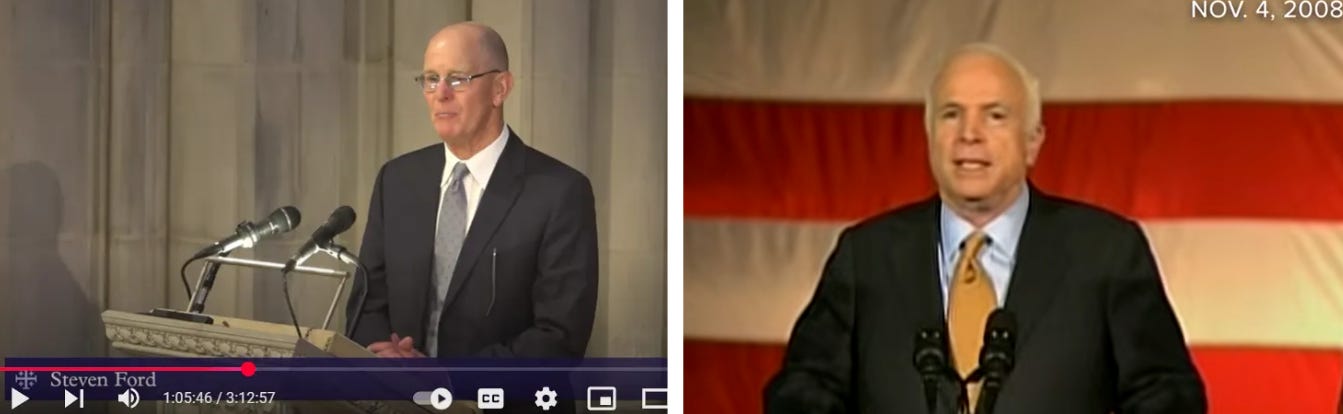
President Gerald Ford, via his son Steven, championed these same values in a eulogy that, before his own death in 2006, he wrote for his predecessor, President Jimmy Carter. My January 2025 essay “Jimmy Carter: Exemplar of Decency and Sense” contains all of the eulogies that family members and prominent political figures wrote for Carter (Vice President Walter Mondale, who died in 2021, entrusted the eulogy that he wrote to his son Ted). Below in its entirety is Ford’s.
By fate of a brief season, Jimmy Carter and I were rivals. But for the many wonderful years that followed, friendship bonded us as no two presidents since John Adams and Thomas Jefferson. It has said that President Adam’s last words were, Thomas Jefferson still survives.
Now, since Jimmy has a good decade on me, I’m hedging my bets by entrusting my remembrances of Jimmy to my son, Steve. According to a map, it’s a long way between Grand Rapids, Michigan, and Plains, Georgia. But distances have a way of vanishing when measured in values rather than miles. And it was because of our shared values that Jimmy and I respected each other as adversaries, even before we cherished one another as dear friends.
Now, this is not to say that Jimmy never got under my skin, but has there ever been a group of politicians that didn’t do that to one another? During our 1976 contest, Jimmy knew my political vulnerabilities, and he successfully pointed them out. Now, I didn’t like it, but little could I know that the outcome of that 1976 election would bring about one of my deepest and most enduring friendships.
In the summer of 1981, the two of us found ourselves together again, this time aboard Air Force One bound for the funeral of the great peacemaker Anwar Sadat. There’s an old line to the effect that two presidents in a room is one too many.
Frankly, I wondered how awkward that long flight might be to Cairo, and it was a long flight, but the return trip was not nearly long enough for it was somewhere over the Atlantic that Jimmy and I forged a friendship that transcends politics. We immediately decided to exercise one of the privileges of a former president, forgetting that either one of us had ever said any harsh words about the other one in the heat of battle. Then we got onto much more enjoyable subjects, discussing our families, our faith, and sharing our experiences in discovering that there is indeed life after the White House.
We commiserate over the high cost of building presidential libraries and the even more regrettable fact that most of that fundraising for these otherwise admirable institutions fell to us personally. On the spot, we agreed to participate in programs at each other’s library, beginning with a series of conferences on arms control. And if that wasn’t newsworthy enough, we told reporters on the plane that a lasting Middle East peace would require the United States to make tough decisions, like confronting the Palestinian issue directly. Thereby, building on the work to which President Sadat had literally given his life.
It was the first time, but by no means the last time, that our unlikely partnership ruffled feathers in the Washington establishment.
Now, honesty – Jimmy Carter. Yes. Those traits were instilled (INAUDIBLE) his loving parents, Lillian and Earl Carter. And the strength of his honesty was reinforced by his upbringing in the Rural South, poised on the brink of social transformation.
He displayed that honesty throughout his life as a naval officer, state legislator, governor, president, and world leader. For Jimmy Carter, honesty was not an aspirational goal, it was part of his very soul.
Now, I think Jimmy wrote more books than any former president. Once asked if he really enjoyed writing, he replied with that familiar twinkle in his eye, “It beats pickin’ cotton.” But I think he enjoyed writing for another reason. As an author, he was under no pressure to tailor his opinions to some political constituency or potential contributor.
Now, both of us had experienced the harsh reality that defeat at the polls can be painful, but we also came to know a more important consequence, political defeat and writing can also be liberating. If it frees you to discuss topics that aren’t necessarily consistent with short-term political popularity.
Now, Jimmy learned early on that it was not enough merely to bear witness in a pew on a Sunday morning inspired by his faith. He pursued brotherhood across boundaries of nationhood, across boundaries of tradition, across boundaries of cash. In America’s urban neighborhoods and in rural villages around the world he reminded us that Christ had been a carpenter. And in third world villages, he successfully campaigned not for votes, but for the eradication of diseases that shame the developed world as a ravage the undeveloped one.
Now, of course, not all of Jimmy’s time was spent building houses, eradicating disease, brokering ceasefires, monitoring elections. While Jimmy is probably the only former president to conduct a weekly bible class I know for certain he’s the only former president to perform a duet of “On the Road Again” with Willie Nelson.
Georgia wasn’t just on Jimmy’s mind, it was in his blood. However far he traveled, he never forgot where he came home to, or where now, in the end, he would finally come home to.
Of the many things Jimmy and I had in common, the most important is this, we both married way above ourselves, way above. With Jimmy, every step of the way was his first lady from Plains in a life rich with blessings, none was greater for Jimmy than the love he shared with Rosalynn and the love the two of them shared with their children, grandchildren, great grandchildren.
Like Jimmy, Rosalynn was and is a symbol of American compassion. Like no other first lady in our history, Rosalynn Carter is indeed a true citizen of the world. And she became a beloved friend to my wife, Betty and me and to all the Ford family. While the Carter and Ford men were decidedly mixed record when it came to lobby in Congress, Rosalynn and Betty were unbeatable in their advocacy for millions of people whom they brought out of the shadows of despair and shame.
Now, is a time to say goodbye. Our grief comforted with the joy and the thanksgiving of knowing this man, this beloved man, this very special man. He was given the gift of years and the American people and the people of the world will be forever blessed by his decades of good works.
Jimmy Carter’s legacy of peace and compassion will remain unique as it is timeless. The entire Ford family, we extend our love to you, and we add our prayers to the prayers of tens of millions of people around the world. May God bless and watch over this good man. May he grant peace to the Carter family. As they say goodbye to a man whose life was lived to the fullest, with a faith demonstrated in countless good works, with a mission richly fulfilled, and a soul rewarded, with everlasting life.
As for myself, Jimmy, I’m looking forward to our reunion. We have much to catch up on. Thank you, Mr. President. Welcome home, old friend.
Upstream from his final paragraph, Schmidt wrote of election night 2008. As a strategist for McCain, Schmidt had turned around the failing campaign and helped achieve the Republican nomination for president. Ultimately, McCain lost to Obama. Below from Schmidt’s essay is an excerpt about McCain’s concession speech:
Can you remember when decency was expected instead of ridiculed?
Eighteen years ago, on a November night in Arizona, John McCain lost the presidency.
He won something greater: his dignity. Standing before disappointed supporters, he declared:
“The American people have spoken, and they have spoken clearly.”
Then he said of Barack Obama:
“I urge all Americans who supported me to join me in not just congratulating him, but offering our next president our goodwill and earnest effort to find ways to come together.”
Finally, he reminded the nation:
“Whatever our differences, we are fellow Americans.”
Those weren’t the words of a defeated politician.
They were the words of a patriot.
Among the readers of Decency and Sense are a fair number of people who identify as right of center and even as members of the Republican party. To such readers especially I implore a patriotic centering of decency, dignity, compassion, and sense in our political life at all levels. I beg that they – as must we all – take up the responsibility to elevate these values above political habits of mind and expression. We must all stand up for the values upon which the founders and framers counted in launching the American experiment. To repeat, “virtue is not quaint — it is essential.”
It's a bleak time when you, Steve Schmidt, several deceased elected officials, and former elected officials have to be quoted to explain and remind Americans that “virtue is not quaint — it is essential.” Thank you.